Free playbook Sales & Outreach
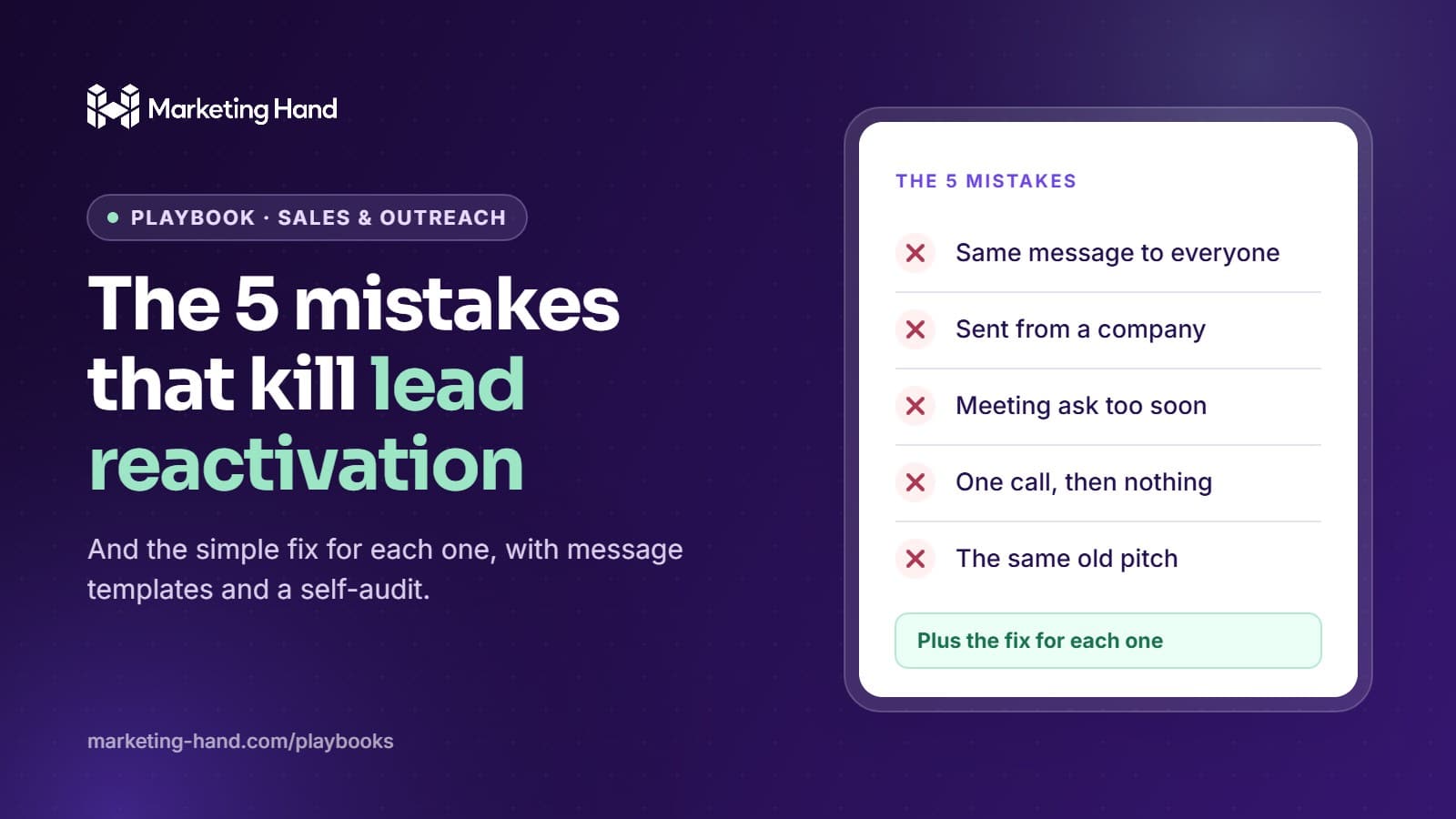
The 5 mistakes that kill lead reactivation (and how to fix each one)
Most campaigns to win back old leads fall flat for the same five reasons. Here is what each mistake looks like, why it hurts your replies and the fix, with message templates and a 10-minute self-audit.
What you needFree: your CRM and an email account. Optional, paid: a text message tool such as Twilio, and a dialler or AI calling tool for follow-up calls.
In this playbook
Most businesses are sitting on a CRM full of people who once asked about their product and then went quiet. Winning back even a small share of them is one of the cheapest sources of new sales you have, because you have already paid to get those leads.
Yet when businesses try a reactivation campaign, many decide it “doesn’t work for us”. In most cases the idea was fine. The campaign made one or more of five avoidable mistakes. Here is what each one looks like, why it hurts your replies and how to fix it.
The short version
- Segment first. A dormant list is several different groups of people. Write a message for each group, not one for everyone.
- Send from a person. People reply to people, not to an info@ address or a company name.
- Ask a small question first. Save the meeting request for the second or third message.
- Follow up properly. One call and a voicemail is not a campaign. Plan at least seven touches across email, text and phone.
- Give them something new. If your message could have been sent on the day they first enquired, rewrite it.
Before you start: only contact people you have permission to contact. In the UK, the Privacy and Electronic Communications Regulations (PECR) cover marketing emails, texts and calls, and the rules are different for individuals and companies. If you are unsure, check the ICO’s guidance before you send anything.
Mistake 1: Sending the same message to everyone
What it looks like
You export 2,000 dormant leads from your CRM, write one email and press send. Or you hand the list to an assistant with a single text message template, or load it into a dialler with one script.
It is the most common mistake, and usually the most expensive.
Why it hurts your replies
A dormant CRM is not one list. It is at least four lists stuck together:
- People who enquired last week and nobody followed up
- People who got a quote six months ago and chose a competitor
- People who started a free trial 18 months ago and never came back
- People who downloaded a guide three years ago and have probably forgotten you
Send all of them “Just checking in” and you treat a warm lead the same as a cold one. The warm lead thinks you are disorganised. The cold lead thinks you are spamming. Both delete it.
What it costs you
You lose the easy wins first. The people closest to buying, who only needed a relevant nudge, get the same vague message as everyone else. Some of them will buy from a competitor who followed up properly.
The fix
Segment before you send. Start with four simple cuts:
- Source: paid ad, organic search, referral, event or partner
- Original intent: price enquiry, demo request, content download, free trial or direct enquiry
- Time since they went quiet: 90 to 180 days, 180 days to a year, or more than a year
- Last sign of interest: opened an email, answered a call, replied to a text, or nothing at all
Then write one message for each group that matters. You don’t need a message for every combination. Three to five messages usually cover most of the list.
Here’s an example. A private clinic with 800 old enquiries might split them like this:
- Requested a quote 90 to 180 days ago but never spoke to a clinician: help them finish booking the consultation
- Enquired but never received a quote: give them the pricing they were missing
- Past patients whose last visit was more than 12 months ago: a friendly check-in with a preventative angle
- Everyone else: a short, personal re-introduction from a named member of the team
Four messages and a couple of days’ work, and every person gets something that makes sense to them.
Mistake 2: Sending from your company, not a person
What it looks like
The text comes from “Acme Healthcare” or an 0800 number. The email comes from info@acme.com or marketing@acme.com. The voicemail says “this is the Acme team”.
It feels professional. It rarely gets replies.
Why it hurts your replies
People reply to people. When these leads first gave you their details, they wanted to talk to someone at your business. A message from a company name tells them they are now a record in a marketing database.
Branded, newsletter-style messages also look like bulk marketing, so they are easier to ignore and more likely to be filtered.
What it costs you
The same list and the same words can get very different results depending on who appears to be sending them. If it looks like a campaign, people treat it like a campaign.
The fix
Always send from a named person.
For text messages
- Use a dedicated number from a provider such as Twilio, linked to one named person
- Sign every message with that person’s first name
- If an AI tool sends messages or calls on that person’s behalf, it should say so clearly
For email
- Send from “Sarah Carter, sarah@yourdomain.com”, not “Acme Healthcare, info@acme.com”
- Skip the logo header and the newsletter-style footer. Keep a simple line that lets people opt out, but make the email look like a note from a colleague, not a campaign
- Use plain text or very simple formatting
For phone calls
- If you use an AI voice agent, it should introduce itself by name and say it is an AI assistant calling on behalf of your business. For example: “Hi, I’m Sarah, the AI assistant calling for Acme Healthcare.”
- Call from a UK landline or mobile number registered to your business, not an 0800 number
This is one of the quickest changes you can make: the same list and the same scripts, just a different sender.
Mistake 3: Asking for a meeting in the first message
What it looks like
“Hi Sarah, it’s been a while since we spoke. Do you have 15 minutes this week to catch up?”
Or worse, a calendar link in the very first text.
Why it hurts your replies
After months of silence, a meeting is a big ask. You are asking for their time before you have won back their interest.
Robert Cialdini’s commitment and consistency principle explains why a small yes works better first: once someone has agreed to something small, a bigger request feels like a natural next step. Your first message has one job. Get a reply.
What it costs you
People who would happily say “yes, still interested” stay silent, because replying would commit them to a call they are not ready for.
The fix
Make the first message one small question that is easy to answer. Here are three templates you can adapt:
“Hi [name], it’s [your first name] from [company]. We spoke a while back about [topic]. No pressure, just checking: is this still on your radar? Reply Y or N either way and I’ll close the loop.”
“Hi [name], I noticed your enquiry from [month] is still open on our system. I’ll close the file unless [the thing they wanted] is still useful. Worth keeping open?”
“Hi [name], quick one. We’ve just [specific change since they enquired]. Worth a five-minute look, or shall I close your file?”
Good first messages have a few things in common:
- Fewer than 50 words
- One easy question
- Clear permission to say no (“I’ll close the file”)
- A specific reference to their original enquiry, so it doesn’t feel like a mass send
- Sent from a named person
Ask for the meeting in the second or third message, once they have replied. By then it is a natural next step rather than a cold ask.
Mistake 4: One call, one voicemail, then nothing
What it looks like
A salesperson calls a dormant lead. No answer. They leave a voicemail, mark the record “left voicemail” and move on.
Why it hurts your replies
Three things work against a single call.
1. Most calls never connect. ZoomInfo reports that 81 per cent of calls from unknown numbers go to voicemail, and only 67 per cent of people check voicemail from unknown numbers. A single voicemail is a weak plan.
2. Most sales need several follow-ups. The same ZoomInfo research found that 80 per cent of sales need five or more follow-up calls. One attempt is a small fraction of the effort needed.
3. Timing matters. Research summarised by Claim Supply found that firms calling within five minutes were 21 times more likely to qualify a lead than those that waited 30 minutes. For a dormant lead, the moment to call is when they show a new sign of interest: they reply to a text, open your email several times or click a link. Most teams notice the next morning, by which time the moment has passed.
What it costs you
Leads you have already paid for sit in your CRM marked “no answer”, when many of them were never properly followed up at all.
The fix
Make three changes, in order of impact:
- Use several channels, not the same one five times. Spread your touches across text, email and phone over about 14 days. People who ignore calls often reply to a text within minutes. People who ignore texts may open an email later in the day.
- React to signs of interest quickly. Set up an automation so that a reply, a link click or several email opens creates an instant alert or task for a salesperson. If you use an AI calling tool, it can call back within a minute, day or night.
- Decide what “followed up” means. For example: seven touches across three channels. Build that into your sequence, so a lead is not marked as dead until it has had a fair chance.
Mistake 5: Re-sending the original sales pitch
What it looks like
A “we’d love to reconnect” email that pitches the same service, in the same way, with the same offer that didn’t win them over six months ago.
Why it hurts your replies
Leads usually go quiet for a reason, most often timing or fit. Your original pitch didn’t solve their problem at that moment. Sending it again is like asking the same question to someone who has already said no and expecting a different answer.
It also looks familiar. If your reactivation email reads like the one they ignored four months ago, it is likely to be ignored in exactly the same way.
What it costs you
You use up one of your few chances to get their attention and give them no new reason to reply.
The fix
Every reactivation message needs at least one thing that has changed:
- A new offer or price. “Since you enquired, we’ve introduced a payment plan that wasn’t available when we last spoke.”
- A new product or service. “We’ve launched [thing]. I wanted to mention it because of your original enquiry.”
- New proof. “We’ve just published a case study from a business like yours that achieved [specific result].” Proof from a similar business is especially persuasive.
- A genuine deadline. “We’re closing enquiries older than 12 months at the end of this month, so I wanted to give you the chance to keep yours open.” Only use this if it is true.
- A new question. No pitch at all: “Did you ever get [their original problem] sorted?”
Pick one and build the message around it. If nothing in your business has changed since they went quiet, that is worth fixing too. In the meantime, a genuine new question (number 5) always works as an angle.
A simple test: if your message could have been sent on the day they first enquired, it is the original pitch. Rewrite it.
How the mistakes add up
Most campaigns don’t make just one of these mistakes. They make three or four at once, and each one makes the others worse.
Here’s an example. A consultancy with 1,500 dormant enquiries sends one email to the whole list (mistake 1) from hello@ its company address (mistake 2), asking for a 30-minute call (mistake 3). Nobody follows up (mistake 4), and the email repeats the offer those people ignored last time (mistake 5).
A handful of people book a call, and the team decides reactivation doesn’t work for their business. The list was never the problem. The campaign was.
Fix all five and the same list gets a relevant message, from a real person, with an easy first question, proper follow-up and a genuine reason to reply.
A 10-minute self-audit
If you have run a campaign to dormant leads in the last 12 months, answer these honestly:
| Question | Your answer |
|---|---|
| Did you split the list into groups before sending, using at least four cuts? | Yes / No |
| Was every message sent from a named person, not a company? | Yes / No |
| Did the first message ask for something smaller than a meeting? | Yes / No |
| Did the sequence include at least seven touches across three channels? | Yes / No |
| Did each message include something genuinely new since they went quiet? | Yes / No |
Every “No” is a place where replies are slipping away. Start with the first “No” on the list and fix that before your next send.
Your next step
Most reactivation campaigns start with an email, so check yours before it goes to the whole list.
The free Email Grader is a Claude skill that scores your email, explains what is helping and hurting your chance of a reply, and marks the evidence inside the email itself. Run your first reactivation message through it, fix what it flags, then send.
Sources
- ZoomInfo, Cold Calling Statistics: 2026 Benchmarks and Data for B2B Sales Teams: 81 per cent of calls from unknown numbers go to voicemail, 67 per cent of people check voicemail from unknown numbers, and 80 per cent of sales need five or more follow-up calls.
- Claim Supply, speed-to-contact research: firms calling within five minutes were 21 times more likely to qualify a lead than those that waited 30 minutes.
- Robert Cialdini, Influence: The Psychology of Persuasion: the commitment and consistency principle.