Free playbook Sales & Outreach
How Email Grader Scores a Cold Email, and Where the Score Comes From
How the six-area Email Grader scorecard works, where each criterion comes from, and what happened when we graded the same email in a plain chat.
What you needClaude (Free, Pro, Max, Team or Enterprise, with code execution enabled) and the free Email Grader. No paid tools needed.
In this playbook
Ask a chat assistant whether your cold email is any good and you will get an answer. It will sound confident, it might include a score, and it will be different the next time you ask. That makes it hard to know whether your second draft is genuinely better than your first.
Email Grader gives every email the same six checks, the same weights and the same rules, and ties each judgement to the exact words in your email. This playbook shows you what those checks are, where they come from, what a real graded email looks like, and what happened when we put the same email through a plain chat.
The short version
- Six areas, one score out of 100. Relevance, a problem-led opening, the call to action, proof, brevity and the subject line, each with a fixed weight.
- Four gates sit on top. If the email fails one, the score is capped below 60 however good the rest is.
- The criteria come from published research. Five peer-reviewed studies, seven published email analyses, official sender rules from Google, Yahoo and Microsoft, and ten classic direct-response books.
- Every judgement is marked against your own words. You see which line cost you, and why.
- The weights are our judgement, informed by the evidence. They are not a calibrated prediction of replies, and the grader never says they are.
- Free diagnoses. Pro fixes. The free version scores and explains. Pro rebuilds the email.
Before you start
Email Grader grades the copy of an email. It cannot see your list, your offer or your timing, and it cannot check that your domain is set up properly or guarantee where an email lands. A higher score means the email follows what the evidence supports. It does not promise more replies, and the projected score it shows after a fix is always labelled “Projected score, not a promised reply rate”.
It is built for people who send cold B2B email: founders, small business owners, salespeople and agencies. It is not for e-commerce newsletters.
Part 1: The scorecard
Every email is scored out of 100 across six areas. The weights add up to 100.
| Area | Weight | What it checks |
|---|---|---|
| Relevance and targeting | 25% | Whether the email is clearly for this person right now, rather than a message anyone could have received |
| Problem-led opening | 20% | Whether it opens on a problem the reader recognises, instead of on you, your company or your product |
| CTA quality | 20% | Whether there is one clear, low-effort next step that matches how cold the relationship is |
| Proof and credibility | 15% | Whether there is a reason to believe you, such as a comparable customer or a real number, rather than a claim on its own |
| Brevity and readability | 10% | Whether it is short enough to read on a phone in one pass, around 50 to 125 words, carrying one idea |
| Subject line | 10% | Whether it looks like a normal internal email, and whether the body delivers what it promised |
Why relevance carries the most weight
A cold email is a request from a stranger, so the first question the reader asks is “why me, and why now?”. One published analysis of about 11 million emails, plus a survey of decision-makers, reported that 71 percent of the people surveyed do not reply because the email does not address a problem relevant to them. The classic direct-response writers said the same thing decades earlier: pick the right market before you worry about the wording.
Relevance does not mean a personal detail about the reader. A merge field that fills in a city name is fine. A line that claims you looked someone up, when the specific detail is a blank or generic, reads as fake personalisation and is marked down.
Why the opening matters
One analysis of about 28 million emails reported that pitching in the email reduced replies by as much as 57 percent. The grader reads the first line to see whether you start with the reader’s situation or with yourself.
Why the call to action is weighted so heavily
The ask decides whether the reader replies at all. A large published analysis of cold-email calls to action found that a simple interest question tends to work better on a first, cold message, and a specific day and time works better once there is a live conversation. The grader scores the ask against how cold the relationship is. A 30-minute meeting request from a stranger scores lower than a low-effort question.
One of the peer-reviewed studies also helps here. In a classic field experiment on queue-jumping at a photocopier, people were far more likely to agree to a large favour when the request came with a real reason (42 percent) than with no reason (24 percent). A reason that sounded like one but said nothing did no better than no reason at all (24 percent). So the grader rewards a genuine “why now” and gives no credit for filler.
Proof, brevity and the subject line
Proof is scored on specifics. A named, similar customer or a real number counts. “Experienced team” and “tailored approach” do not, because every competitor can say them.
Brevity is partly counted rather than judged. An analysis of about 40 million emails found that messages of 50 to 125 words had the best response rates, so the grader counts your words and treats that range as a ceiling to stay under, not a target to hit.
Subject lines carry 10 percent of the score because they decide whether the email gets read, but a short subject on its own cannot rescue a weak body. A subject that is clickbait, or that fakes a relationship, fails outright.
Part 2: The four gates
Some problems cannot be balanced out by doing other things well. A subject line that looks like marketing, or a call to action that asks too much, will sink the email whatever else is in it. So the grader runs four gates before the weighted score counts:
- Deliverability. Plain text, a real greeting, a human sign-off and no links in a cold first message.
- Subject. Does it look like something a real person would type to a peer?
- Relevance. Is the opening about the reader, or about the sender?
- Call to action. Is there one clear, low-effort ask?
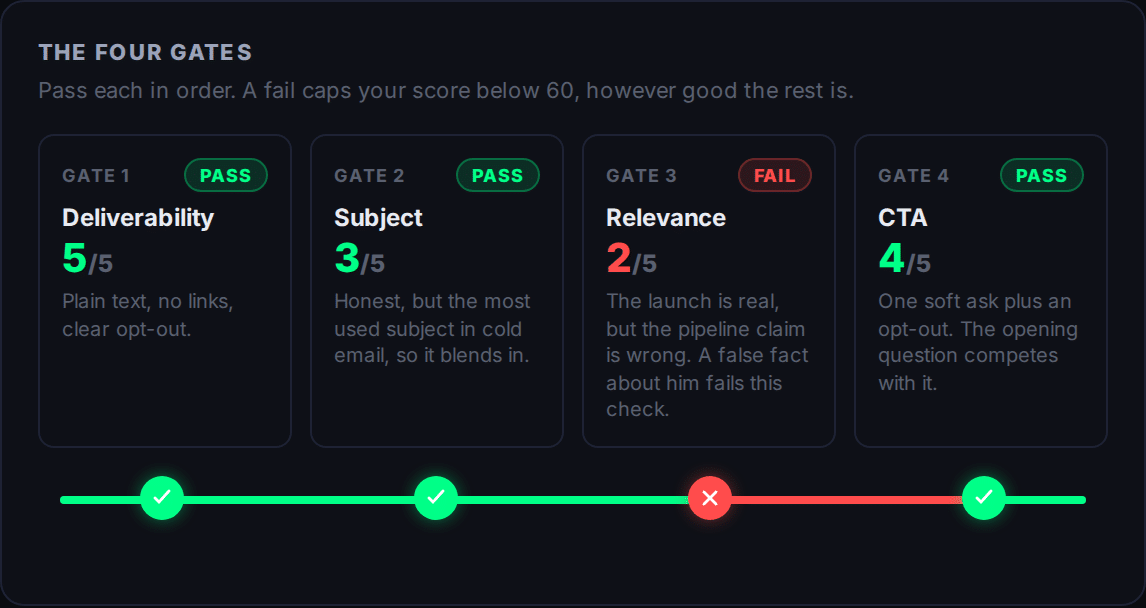
Each gate passes or fails. A failed gate caps the score below 60, however good the rest is. Two failures cap it lower still. The caps keep a polished-looking email with one fatal flaw from scoring well.
Part 3: Where the score comes from
Every criterion in the rubric traces to a source. We tag each source by how strong the evidence is, so a randomised experiment is never treated as equal to an opinion.
| Evidence level | What it means |
|---|---|
| Proven | Peer-reviewed field experiments or large randomised studies. The strongest level. |
| Official | Rules or measurements published by the mail providers themselves. |
| Large vendor dataset | Big observational datasets from credible companies. Useful for direction, but they are not randomised and the companies have a commercial interest. |
| Practitioner | Agreement among respected operators with little or no controlled data. |
| Heritage | The foundational books of the craft. Their authority is reputation and longevity. |
A rubric that weights an anecdote the same as a randomised experiment is, in the words of our own evidence file, opinion with a number stapled on. So higher-evidence levers get more weight than fashionable tactics.
The five peer-reviewed studies
- Personalisation. A large randomised field experiment across three companies found that putting the recipient’s name in the subject line lifted leads by 31 percent and cut unsubscribes by 17 percent. The lists were opt-in rather than cold, so we treat the direction as transferable and the exact size as not.
- Reasons. The photocopier study above. The real lesson is to give a real reason for a real ask.
- Question-asking. Research across more than 600 online conversations and a speed-dating field study found that asking follow-up questions makes people like you more. It was not tested on cold email, so applying it there is a reasonable inference. It is why a genuine question works as a low-friction ask.
- Sender authority. Two field experiments tested adding a CEO title to the sender line. Among prospects it lifted click rates by 75 percent and also raised unsubscribes by 177 percent. Among existing customers the effect was not significant. We treat it as the weakest of the five, and the grader warns against overplaying authority.
- Social proof. A well-known study of hotel towel reuse found that a message citing what similar guests do beat a standard appeal. A later study failed to fully replicate it, so we call it influential but contested. It supports specific, similar proof over a generic logo wall.
The seven published email analyses
Seven large analyses from sales and outreach companies inform the criteria on length, subject lines, pitching, calls to action and relevance. Their reported sample sizes add up to about 296 million emails. Some of those datasets share underlying data, so the number of different emails is lower, and counting each source once it is still over 200 million. We use their findings as direction, not gospel. They are observational, and several of the companies sell outreach products.
Official sender rules
Google, Yahoo and Microsoft publish requirements for bulk senders: authentication, easy unsubscribe and low complaint rates. They decide whether your email reaches the inbox at all, so the deliverability gate assumes they are handled. Apple’s Mail Privacy Protection loads tracking pixels whether or not a human reads the email, which is why Email Grader judges the likelihood of a reply and does not use open rate.
Ten classic direct-response books
The craft was written down long before email. The rubric draws on Schwartz on awareness, Halbert on choosing the market before the message, Hopkins and Caples on testing and the headline, Cialdini on persuasion, Collier on joining the conversation already in the reader’s mind, Bly on benefits, Ross and Tyler on short referral-style outreach, and Blount and Weinberg on consistent prospecting and customer-focused messaging.
What this does not mean
The six weights are a product rubric informed by all of the above. They are evidence-informed starting values and not a scientifically calibrated formula, and the grader does not claim that a higher score proves more replies. Trust the band your email lands in more than a gap of two or three points.
Part 4: A real email, graded
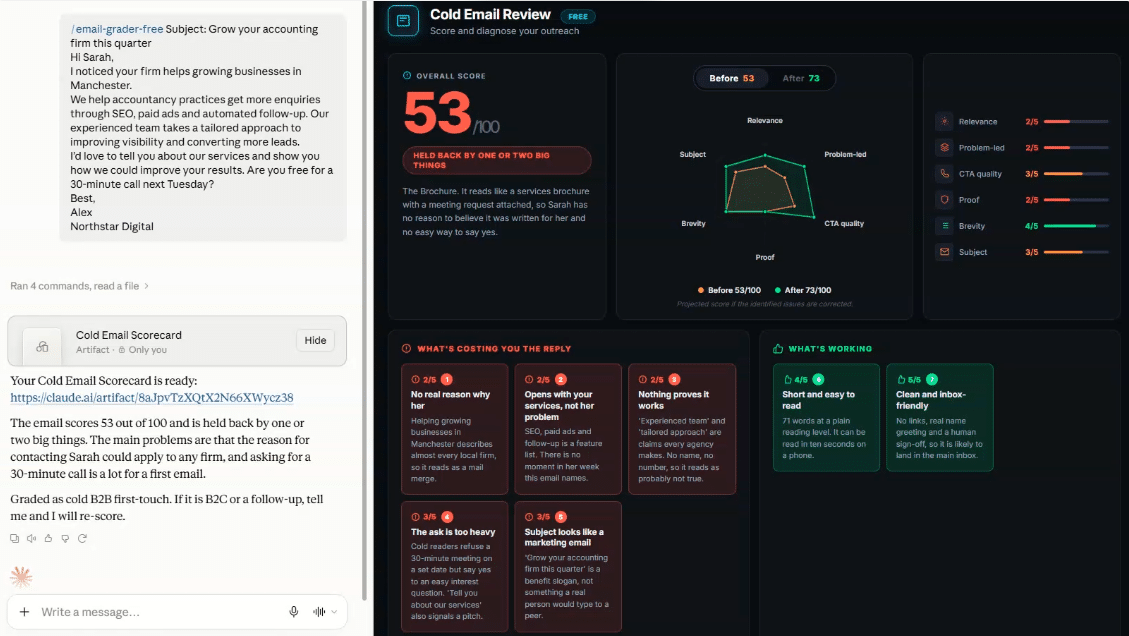
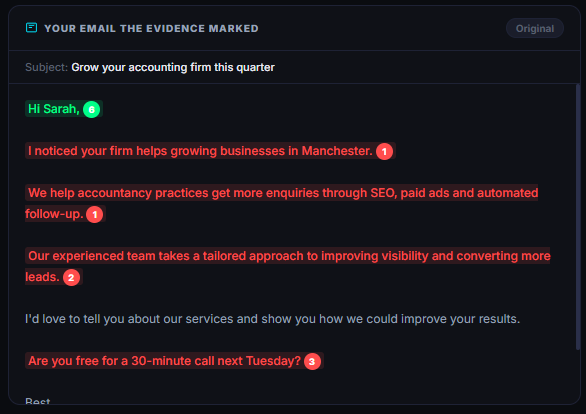
Here is an example email we use in the free demo. It reads fine at first glance.
Subject: Grow your accounting firm this quarter
Hi Sarah,
I noticed your firm helps growing businesses in Manchester.
We help accountancy practices get more enquiries through SEO, paid ads and automated follow-up. Our experienced team takes a tailored approach to improving visibility and converting more leads.
I’d love to tell you about our services and show you how we could improve your results. Are you free for a 30-minute call next Tuesday?
Best,
Alex
Northstar Digital
Email Grader Free scored it 53 out of 100.
| Area | Score |
|---|---|
| Relevance | 2 / 5 |
| Problem-led | 2 / 5 |
| CTA quality | 3 / 5 |
| Proof | 2 / 5 |
| Brevity | 4 / 5 |
| Subject | 3 / 5 |
What works. It is short, at 71 words, and written at a plain reading level, so it can be read in one pass on a phone. It has a real greeting, a human sign-off and no links.
What costs the reply.
- No real reason why her. “Helps growing businesses in Manchester” describes almost every local firm, so it reads as a mail merge.
- It opens with services, not her problem. SEO, paid ads and follow-up form a feature list, and nothing says what is happening in her week.
- Nothing proves it. “Experienced team” and “tailored approach” are claims every agency makes. There is no name and no number.
- The ask is too heavy. A 30-minute meeting on a set day is a big first step, and “tell you about our services” signals a pitch.
- The subject reads like a slogan. It sounds like a benefit, not something a peer would type.
The relevance and CTA gates both failed, which is why the score sits under 60 even though the email is short and clean.
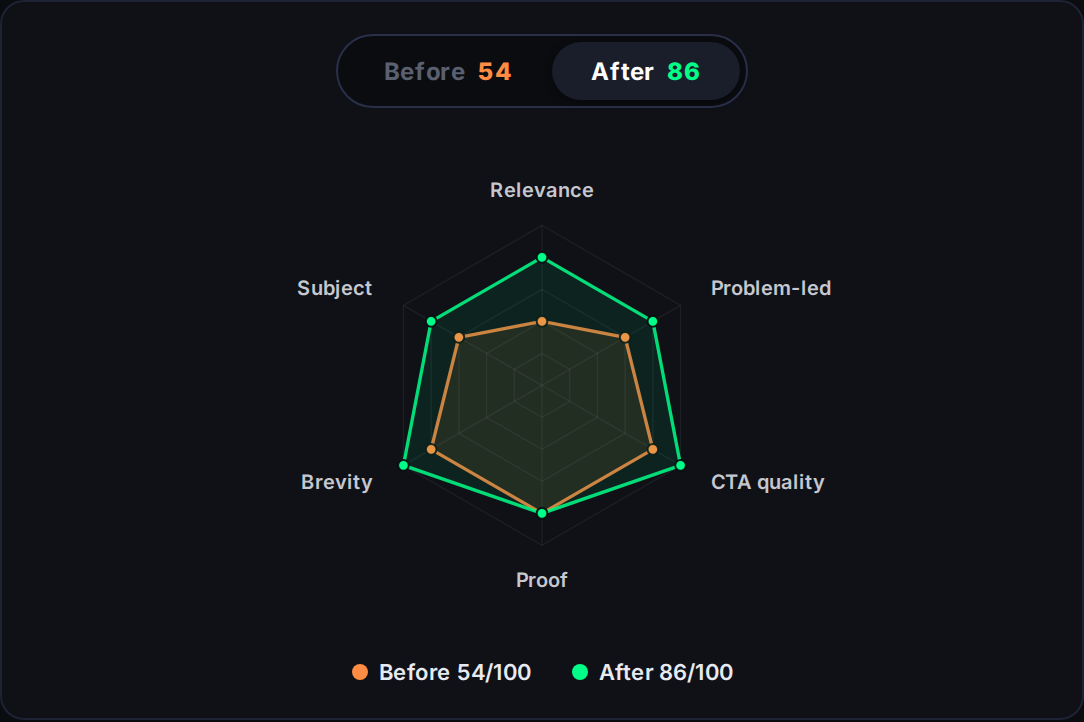
The grader also showed a projected score of 73 if those issues were fixed. That is a guide to where the email could land. It is not a prediction of a reply rate.
Part 5: The same email in a plain chat
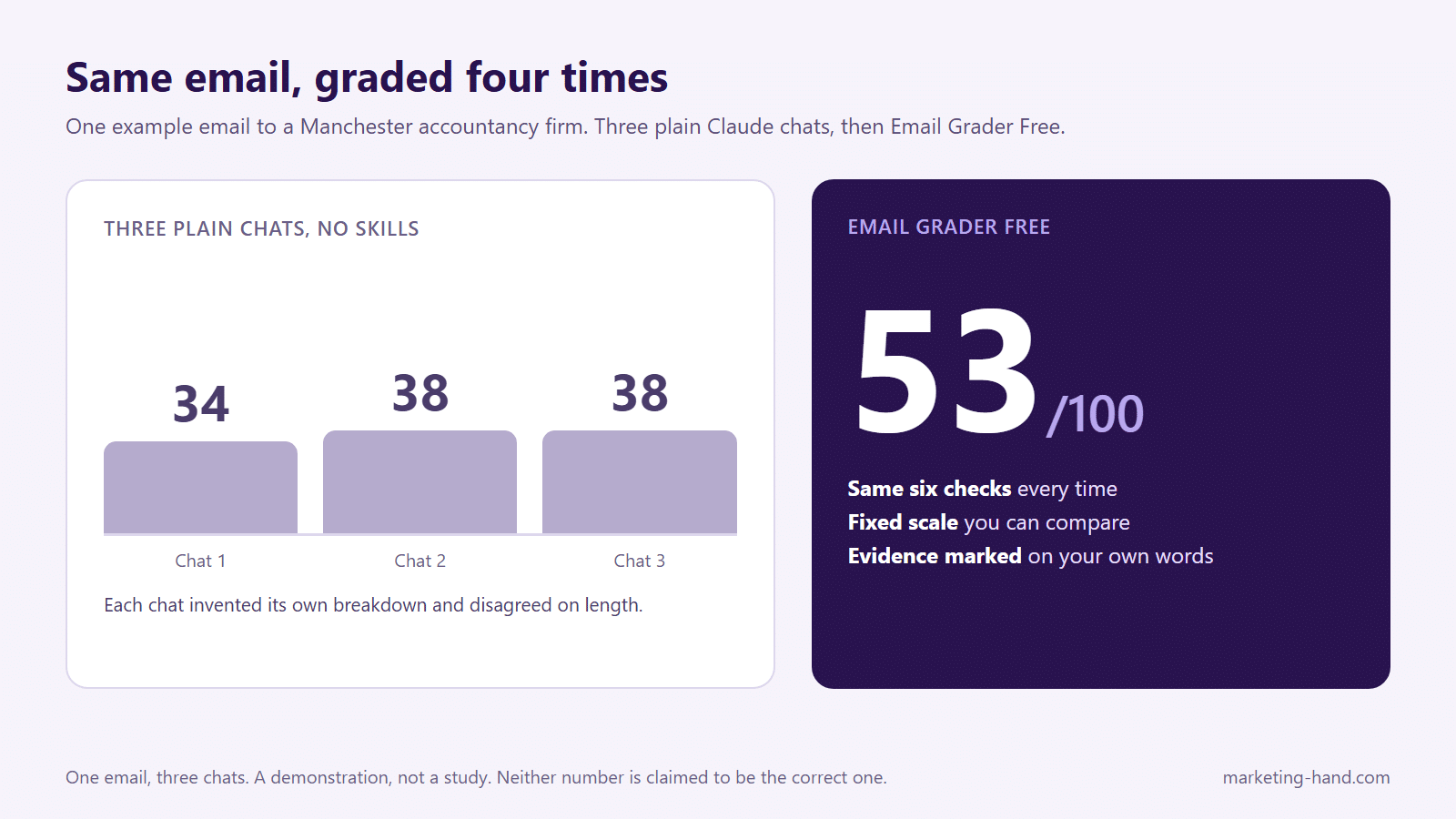
We wanted to know what you actually gain over just asking. So we gave the same email to three separate Claude chats, with no skills, using the same short prompt: “Can you grade it out of 100 and tell me what’s wrong with it?”
They scored it 34, 38 and 38.
What the chats did well. All three found the same big problems: the generic opening, no proof, the heavy ask and the services list. If you only need a quick opinion, a chat gets you most of the way there, and we are not claiming otherwise.
Where they differed.
- No fixed scale. One chat gave no breakdown at all. Another scored each area out of 10, and the third used a mix of out of 15 and out of 25. Each invented its own weights, so you cannot compare a score from one chat with a score from another.
- Different verdicts on the same facts. One chat called the email too long for what it says. Another said the length was fine. The email is 71 words. One chat also marked down the sign-off, where Email Grader found a human sign-off was part of what worked.
- No evidence behind the verdicts. None of the chats said where its rules came from or how strong the evidence was.
- No gates, no projected score. A chat tells you what it thinks. It does not tell you that a failed gate caps the score, or what the email could reach if you fix it.
What Email Grader adds.
- The same checks every time. The countable signals are counted before any judgement is made: 71 words, a reading grade of 8.5, no links, one question, a six-word subject. A word count is a number, not an opinion, so it does not change from run to run.
- Judgements marked on your own words. Each issue points to the line it came from.
- A fixed scale. A 53 today and a 68 tomorrow means the same thing, so you can see whether your changes helped.
- Evidence behind the rules. Each judgement carries its evidence level.
The honest limits. We ran this once, on one email, with three chats. That is a demonstration, not a study. The judgement parts of the score, such as how relevant an opening feels, can still move a point or two between runs. Email Grader scored the email higher than the chats did, and we are not claiming that either number is the correct one. The value is in the consistency and the evidence, not in a higher or lower figure.
Part 6: How to use it
- Install the free skill. Download Email Grader Free, then in Claude go to Customize and Skills and upload the file. Make sure code execution is switched on. Claude Free, Pro, Max, Team and Enterprise all work.
- Paste your email. Include the subject line. If you leave it out, the grader does not mark you down for it.
- Read the four parts of the result. The overall score, the six area scores, the “what’s costing you the reply” cards, and your email with the evidence marked on it.
- Fix the biggest issue first. A failed gate matters more than a small gain in brevity.
- Add context and grade again. If the email is B2C, a follow-up, or you have more background on the reader, tell Claude in the chat and it re-scores on that basis.
By default the grader reads your email as a cold B2B first message, which is the harshest reasonable reading.
Free and Pro
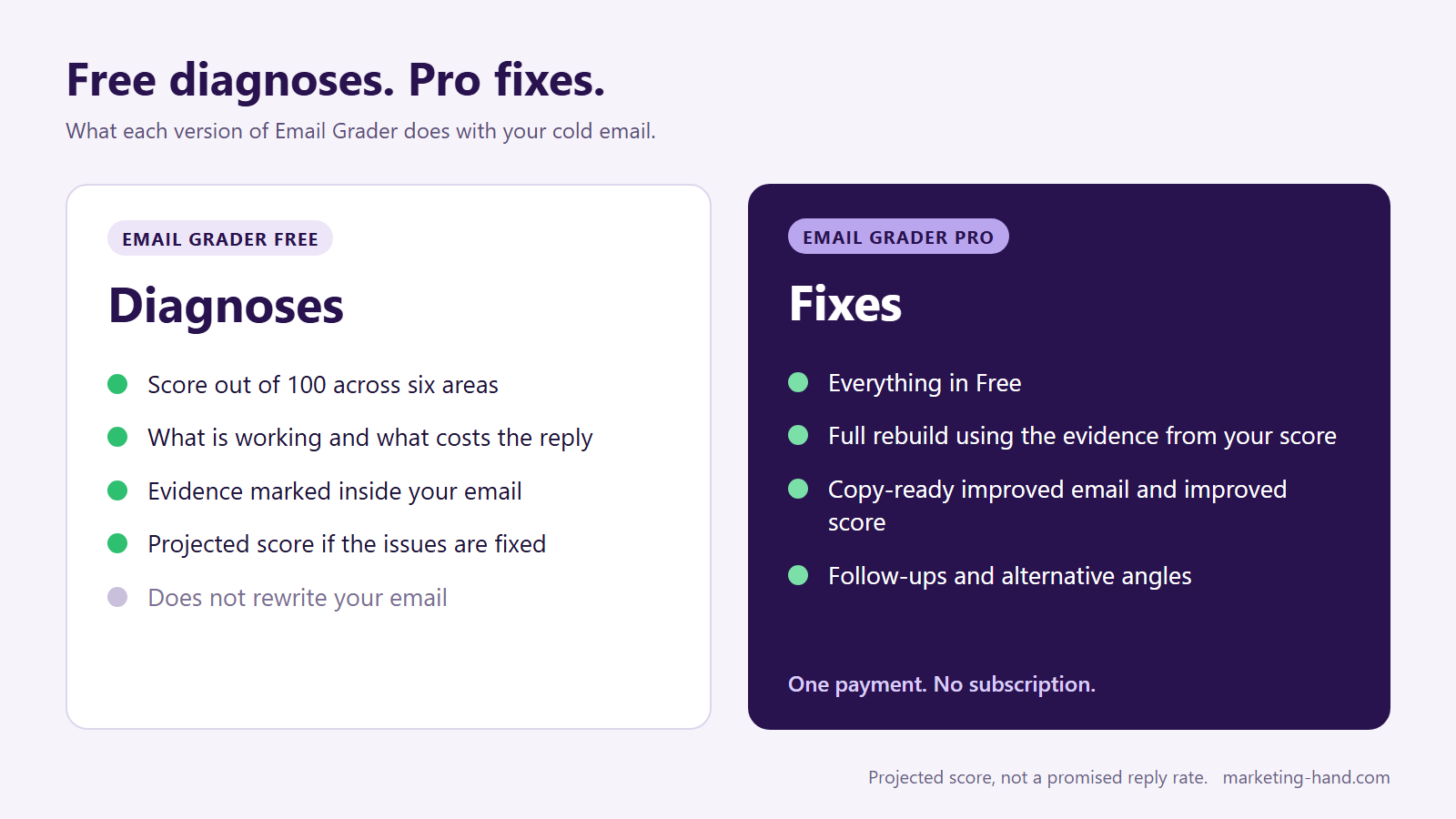
The free version scores the email, explains what is working and what is costing replies, and shows the projected score. It does not rewrite the email.
Email Grader Pro does the next step. It rebuilds your email using the evidence from your score, shows the improved score, and gives you a copy-ready email, follow-ups and alternative angles. It is one payment, with no subscription. Free diagnoses. Pro fixes.
A six-question self-check
Before you send your next cold email, answer each question honestly.
| Question | Area |
|---|---|
| Could this email only have been written for this person, at this moment? | Relevance |
| Does the first line describe a problem they recognise, not your company? | Problem-led |
| Is there one question or request they can answer in a few seconds? | CTA |
| Does it include a real customer or number, not just a claim? | Proof |
| Is it under about 125 words, with one idea? | Brevity |
| Would a colleague plausibly send this subject line to another colleague? | Subject |
Each “no” is a place to lose points. Paste the email into the grader to see which ones cost you most.
Your next step
Grade the next cold email you were about to send, before it goes out.
Sources
Reported study sizes. Some datasets overlap. These findings inform the criteria. They do not predict results.
Peer-reviewed studies
- Sahni, Wheeler and Chintagunta (2018). Personalization in Email Marketing: The Role of Noninformative Advertising Content. Marketing Science, 37(2). https://pubsonline.informs.org/doi/10.1287/mksc.2017.1066
- Langer, Blank and Chanowitz (1978). The Mindlessness of Ostensibly Thoughtful Action. Journal of Personality and Social Psychology, 36(6).
- Huang, Yeomans, Brooks, Minson and Gino (2017). It Doesn’t Hurt to Ask: Question-Asking Increases Liking. Journal of Personality and Social Psychology, 113(3). https://www.hbs.edu/ris/Publication%20Files/Huang%20et%20al%202017_6945bc5e-3b3e-4c0a-addd-254c9e603c60.pdf
- Defau, Zauner and Sycik (2023). How to Improve the Performance of Email Marketing Campaigns? A Field Experiment Using the Authority Principle. Review of Marketing Science, 21(1). https://www.degruyterbrill.com/document/doi/10.1515/roms-2022-0095/html
- Goldstein, Cialdini and Griskevicius (2008). A Room with a Viewpoint. Journal of Consumer Research, 35(3). https://academic.oup.com/jcr/article/35/3/472/1856257
Published email analyses
- Gong, cold-email calls to action. https://www.gong.io/blog/this-surprising-cold-email-cta-will-help-you-book-a-lot-more-meetings
- Gong, does cold email still work. https://www.gong.io/blog/does-cold-email-even-work-any-more-heres-what-the-data-says
- 30MPC and Outbound Squad, the data-backed cold email formula. https://www.30mpc.com/newsletter/the-data-backed-cold-email-formula-the-exact-words-length
- Belkins, B2B cold outreach benchmarks. https://belkins.io/resources/b2b-cold-outreach-benchmarks
- Hunter, the state of cold email. https://hunter.io/the-state-of-cold-email-2025
- Boomerang, getting more responses to your emails. https://blog.boomerangapp.com/2016/02/7-tips-for-getting-more-responses-to-your-emails-with-data/
- Yesware, email subject line analysis. https://www.yesware.com/blog/email-subject-line-analysis/
Official guidance
- Google, email sender guidelines. https://support.google.com/a/answer/14229414
- Yahoo, sender best practices. https://senders.yahooinc.com/best-practices/
- Microsoft, requirements for high-volume senders. https://techcommunity.microsoft.com/blog/microsoftdefenderforoffice365blog/strengthening-email-ecosystem-outlooks-new-requirements-for-highvolume-senders/4399730
- Apple, Mail Privacy Protection, as analysed by Validity. https://www.validity.com/blog/case-closed-the-mystery-of-declining-email-open-rates/
Books
- Schwartz, Breakthrough Advertising. Halbert, The Boron Letters. Hopkins, Scientific Advertising. Caples, Tested Advertising Methods. Cialdini, Influence. Ross and Tyler, Predictable Revenue. Collier, The Robert Collier Letter Book. Bly, The Copywriter’s Handbook. Blount, Fanatical Prospecting. Weinberg, New Sales. Simplified.